
Specialty Gases for Analytical Laboratories and Scientific Testing
A GC that ran clean yesterday can show a noisy baseline today if the new carrier gas cylinder holds a bit more moisture. That’s why specialty gases for laboratories are bought by grade and impurity limits, matched to the instrument. Southwest Gases supplies high-purity nitrogen, argon, and helium to Texas labs, along with calibration gases and custom mixtures.
Specialty Gases for Accurate Laboratory Testing
Every analytical instrument has a gas spec in its manual, and your method may tighten it. An FID measures hydrocarbons, so its gases need almost none. An ECD responds to oxygen, so its gas has to be nearly oxygen-free. Quantified results also need a calibration or reference mixture. Keep the same grade between cylinders so results stay comparable.
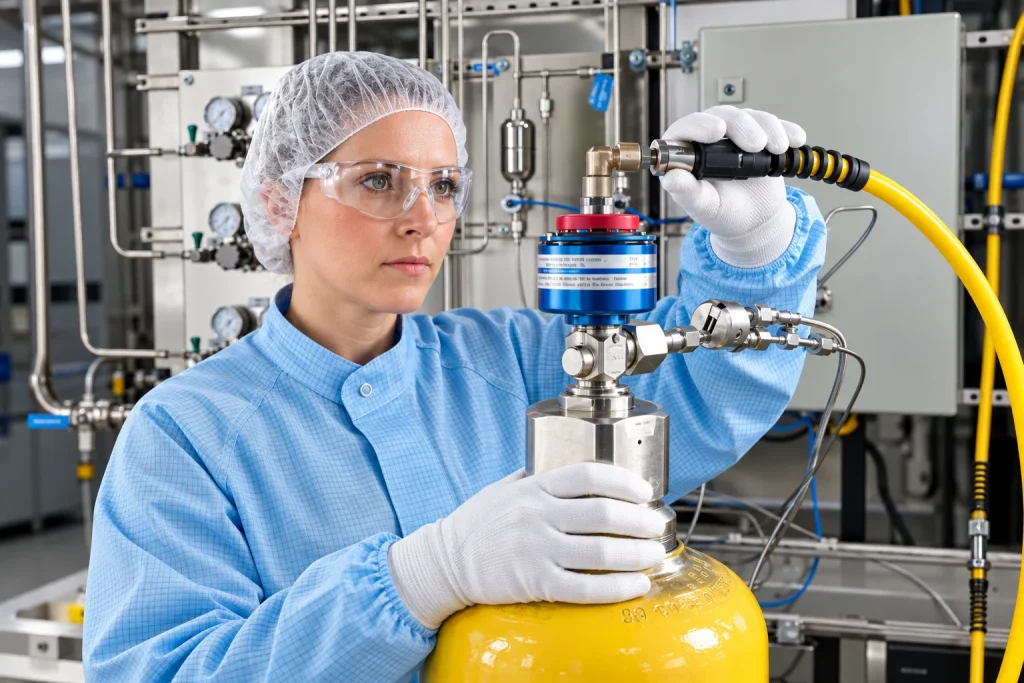
Specialty Gas Applications in Laboratories
Analytical laboratory gases do different jobs depending on the work.
Analytical Testing and Chemical Analysis
Chemistry labs use nitrogen to blanket samples, purge glove boxes and evaporate solvents. Argon takes over where nitrogen would react, such as with lithium metal.
Gas Chromatography and Instrumentation
Gas chromatography carrier gas is usually helium or nitrogen, with hydrogen as a third option. Gases for analytical instruments also include detector fuel, makeup gas and argon for ICP plasma.
Scientific Research and Development
University and R&D labs often need small amounts of several gases, plus one-off mixtures. When choosing a scientific gas supplier, ask about smaller cylinders so stock doesn’t sit unused.
Environmental Testing
Air-quality and emissions labs check analyzers against calibration gases for laboratories, with known levels of gases like CO, NO or SO2. A zero gas sets the baseline.
Keep the Gas Clean After Delivery
A high-purity cylinder only stays high purity if the line from it is clean.
- Change cylinders at about 150 psi or 10% of full pressure, since moisture and hydrocarbons come off the cylinder walls as it empties
- Use a two-stage regulator with a stainless steel diaphragm
- Run stainless steel or copper tubing, because nylon and Teflon let oxygen and moisture through
- Purge the regulator after every cylinder swap
Laboratory Gas Types and Supply Options
Lab gas grades are often written as a number. A 5.0 grade is 99.999% pure, so all impurities together come to no more than 10 ppm. Instrument-grade gases go a step further and cap the specific impurities that bother a given detector.
| Gas Type | Typical Use | What to Check |
|---|---|---|
| High-purity gases (about 4.0 to 4.8) | General lab work, purging, blanketing | Total purity and moisture |
| Ultra-high-purity gases (5.0 and up) | Carrier gas, trace analysis | Oxygen and moisture limits |
| Instrument grade gases | Specific detectors, such as FID or ECD | Limits on hydrocarbons, oxygen or halocarbons |
| Calibration gases and reference mixtures | Quantifying results, checking analyzers | Certified concentration and expiration date |
| Custom gas mixtures | One method or experiment | Components, levels and tolerance |
Laboratory Gas Supply from Southwest Gases
We supply high purity gases for laboratories in cylinders, including nitrogen, argon and helium, plus CO2, calibration gases and custom mixtures. Delivery runs on a schedule or on request across Dallas, Fort Worth, Houston, Austin and San Antonio. Orders come with an SDS, and certificates of analysis are available for graded gases and mixtures. Need hydrogen, zero air or AA fuel gas?
How to Select the Right Laboratory Gas
Start with your instrument manual and method. Then send us the details below, and we’ll match the gas and the cylinder.
| Instrument | Main Gas | Other Gases It Uses |
|---|---|---|
| GC with FID | Helium, nitrogen or hydrogen carrier | Hydrogen and air for the flame, plus makeup gas |
| GC with TCD | Helium carrier in most methods | Argon carrier when measuring hydrogen |
| GC with ECD | Helium or nitrogen carrier | Nitrogen or an argon-methane blend as makeup gas |
| GC-MS | Helium carrier, sometimes hydrogen | Calibration standards for tuning and quantitation |
| ICP-OES and ICP-MS | Argon for the plasma | Helium in some ICP-MS collision cells |
| Flame and furnace AA | Air or nitrous oxide with acetylene | Argon for graphite furnace work |
Why Labs Choose Southwest Gases
Helium is one of our core gases, so GC labs that want to stay on helium have a steady Texas source. Labs inside a plant can order on the same account as the plant’s nitrogen or argon. And as a laboratory gas supplier based in Flower Mound, we answer questions from research groups and QC teams directly, without a national call center.
Request a Quote for Laboratory Specialty Gases
Tell us the gas name, the grade or spec, what it's for, how much you need, and where it's going. Include any documents you need, like a certificate of analysis. Switching from another research gas supplier? Send the grade or part number from your current label, and we'll quote the equivalent.
Frequently Asked Questions
Nitrogen, helium and argon cover most lab work, as carrier, purge and ICP plasma gas. Hydrogen and air feed FID flames, and labs also keep calibration mixtures for their instruments.
Start with the grade your instrument maker and method specify, then check the impurity limits that matter for your detector. A higher grade than the method needs mostly adds cost.
High-purity gases are rated by total purity, such as 99.999%. Instrument grades also cap specific impurities, like hydrocarbons for an FID, so two gases with the same purity can behave differently on your instrument.
Helium, nitrogen and hydrogen are the common carrier gases. Depending on the detector, a GC may also need hydrogen and air for an FID, or a makeup gas for an ECD.
Yes. We supply calibration gases and reference mixtures for lab analyzers. If a method needs specific components or levels, see our Custom Gas Mixtures page.
Send the gas, grade, instrument and method, along with cylinder size and monthly use. For a mixture, add the components, concentrations and tolerance.
We supply laboratory gases including high-purity nitrogen, argon and helium, CO2, calibration gases and custom mixtures. For anything else, ask and we’ll confirm availability before you order.
Yes. We deliver to labs in Dallas, Fort Worth, Houston, Austin and San Antonio. If you’re somewhere else in Texas, ask whether your site is on one of our routes.