
Helium for Laboratory Equipment in Texas
High-Purity Helium Supply for Analytical Instruments, Research Laboratories and Scientific Equipment
Southwest Gases supplies high-purity helium for laboratory equipment to labs across Texas. We handle cylinder programs, manifolded systems, and liquid helium for cryogenic instruments, in certified grades from 99.995 percent up to 99.9999 percent, on delivery intervals set from your measured usage.
Trust icons:
- High-Purity Helium
- Laboratory-Grade Supply
- Reliable Delivery Scheduling
- Texas Technical Support
Why Helium Is Essential for Laboratory and Analytical Equipment
Helium is inert, so it will not react with your sample or with the stationary phase of a column. It also holds usable efficiency across a wide range of linear velocities, which means a small error in flow does not collapse resolution the way it would with nitrogen. Most published and regulated methods were developed on helium for those two reasons.
Grade alone tells you less than it appears to. At 99.999 percent, what governs your results is how the remaining 0.001 percent is made up. Oxygen degrades polysiloxane stationary phases at high oven temperatures. Moisture shifts retention on polar columns. Hydrocarbons raise the baseline on FID and on mass spec. Ask your laboratory helium supplier for the certified limit on each of those three.
We supply high purity helium gas to research laboratories, university departments, environmental testing labs, pharmaceutical QC labs, petrochemical labs and independent contract testing facilities across Texas.
Common Helium Applications in Laboratory Equipment
Gas Chromatography (GC)
Helium for gas chromatography is the standard carrier gas. It does not react with the column, and its van Deemter curve is flat enough that flow drift of a few percent has little effect on peak shape. Most labs run 5.0 grade (99.999 percent) as a minimum. On FID and ECD systems the specification to check is the certified total hydrocarbon limit, because hydrocarbon carryover appears as baseline noise and is not reflected in the overall purity figure.
GC-MS Systems
For GC-MS, helium is still the preferred carrier gas. Hydrogen is reactive in an electron ionization source and can hydrogenate or dechlorinate analytes, which shifts spectra away from library matches and lifts background. Sensitivity at trace levels drops as well. A published GC-MS/MS pesticide residue comparison identified over 90 percent of target compounds at 2 parts per billion on helium, against under 55 percent on hydrogen. We supply ultra high purity helium for GC-MS and GC-MS/MS with a certificate of analysis on every batch.
Spectroscopy Equipment
Helium for spectroscopy equipment covers several instrument types. ICP-MS collision cells run helium at roughly 5 mL/min, where kinetic energy discrimination removes the polyatomic interferences that would otherwise read as false positives on chromium, arsenic and cadmium. Laser ablation systems use helium to transport ablated material to the torch. Some labs still sparge HPLC mobile phases with it. Flow rates in all three are low, so one cylinder often lasts a year or more.
Leak Detection Instruments
Mass spectrometer leak detectors use helium as the standard tracer gas. Its atomic size lets it pass through leak paths that other gases will not, and ambient air holds only about 5 ppm helium, so background signal is negligible. Detection limits on these instruments are typically quoted in the 10 to the minus 11 mbar L/s range. Laboratory helium leak testing does not usually call for ultra high purity; industrial grade at 99.995 percent is adequate for most tracer work.
Cryogenic Laboratory Applications
Liquid helium boils at 4.2 K, and no other cryogen reaches the temperature a superconducting magnet needs. That covers NMR spectrometers, FT-ICR mass spectrometers, dilution refrigerators and cryostats used in low-temperature materials work. We supply liquid helium in dewars for scheduled magnet fills and coordinate around instrument service windows. Because boil-off continues in storage, fill dates are set against your magnet hold time.
Research and Development Equipment
Beyond the named instruments, helium for research laboratories appears in thermal analysis, where its thermal conductivity gives faster equilibration in DSC and TGA runs. It also turns up in permeation and gas transmission testing, pyrolysis GC, and custom rigs built for a single experiment. These tend to be low-volume, irregular orders. We supply them on the same terms as scheduled accounts.
Reliable Laboratory Helium Supply Backed by Local Texas Support
Helium supply has been tight and unpredictable for several years, and each round of global disruption has put laboratories on allocation at short notice. We source domestically where we can and hold redundant supply agreements. Accounts on scheduled programs get priority allocation when volumes are constrained.
Our specialists will spec the cylinder size, regulator and manifold with you before the first delivery rather than after a failed run. Deliveries move on our own fleet across the five Texas metros, with 24/7 emergency dispatch for magnet fills and validation batches that cannot wait for the next route day. Southwest Gases has supplied Texas businesses for over 30 years, and laboratory accounts stay with the same specialist.
Helium Supply Solutions for Laboratories
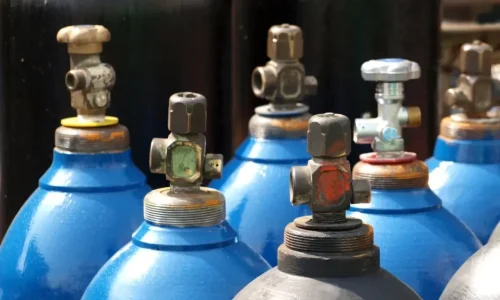
High-Pressure Helium Cylinders
Single laboratory helium cylinders suit a bench running one or two instruments. Sizes run from small portables up to 300 cubic foot cylinders on a CGA 580 outlet, and a 300 will typically supply a split/splitless GC for three to four months. For ultra high purity service, specify a stainless-steel diaphragm regulator. Brass bodies with elastomer diaphragms allow atmospheric moisture to permeate into the line, which degrades the gas you paid a premium for.
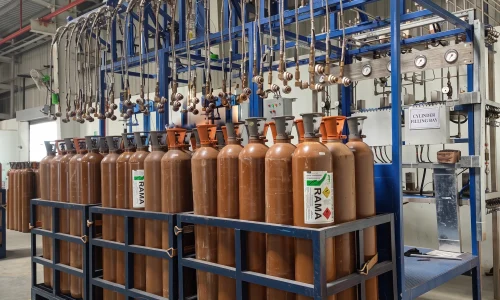
Manifolded Cylinder Systems
A manifold helium system with automatic changeover switches banks when a cylinder empties, so an instrument does not lose supply partway through a sequence. We size a laboratory gas manifold for two-bank operation, which lets one side be refilled while the other stays online. Purge assemblies and point-of-use purifiers are specified alongside the manifold where the application calls for them.
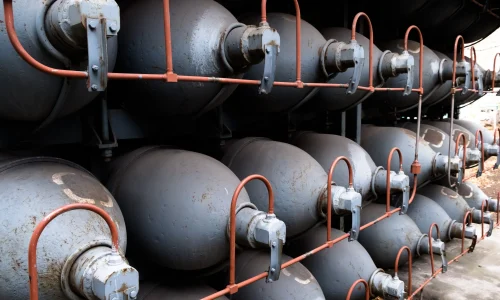
Scheduled Delivery Programs
Scheduled laboratory gas delivery works from measured consumption, not a standard 30-day cycle. We track usage per account and move the interval as instrument load changes across a semester or a contract year. For multi-lab buildings and university campuses, helium delivery in Texas can be consolidated into a single stop with billing split by department.
Serving Laboratories and Research Facilities Across Texas
We run scheduled helium routes to laboratories in Dallas, Fort Worth, Houston, San Antonio and Austin, and to sites in the corridors between them.
The account base includes university chemistry and materials departments, environmental labs running EPA methods, pharmaceutical and food QC labs, refinery and petrochemical labs along the Gulf Coast, and analytical labs attached to semiconductor and aerospace plants in Central and North Texas. Facilities outside those metros should ask about route coverage. We add stops where the volume supports a regular run.
Get a Reliable Helium Supply Partner for Your Laboratory
Certified high-purity helium for laboratory equipment, delivered on intervals set from your usage, with technical support across the five Texas metros. Call 214-432-6583 or email sales@southwestgases.com.
Frequently Asked Questions
Most analytical work runs on 5.0 grade helium (99.999 percent). GC-MS, ICP-MS and trace-level methods usually step up to 5.5 or 6.0 grade ultra high purity helium, which is 99.9995 to 99.9999 percent. Leak detection and general lab use are fine on industrial grade around 99.995 percent. The certified limits on oxygen, moisture and total hydrocarbons matter more than the grade name, so ask for the certificate of analysis.
It is inert, so it will not react with your sample or the stationary phase, and it holds good efficiency across a wide range of linear velocities. That tolerance makes helium methods forgiving, since small flow drift does not collapse resolution the way it does with nitrogen. Most published and regulated GC methods were also developed on helium, so staying with it avoids revalidation.
Yes. We supply ultra high purity helium for GC-MS and GC-MS/MS instruments with a certificate of analysis on every batch. Labs running validated methods can stay on helium and avoid revalidating against hydrogen, which alters in-source chemistry and can cost you library matches.
Laboratory helium cylinders run from small portable sizes for a single instrument up to 300 cubic foot high-pressure cylinders, with multi-cylinder packs for higher-draw benches. Liquid helium is supplied in dewars for cryogenic instruments. We size against your measured consumption, since the largest cylinder that fits the space is not always the cheapest way to buy.
Yes. Scheduled laboratory helium delivery in Texas covers Dallas, Fort Worth, Houston, San Antonio and Austin. Intervals are set from your usage data and adjusted when instrument load changes. Telemetry monitoring is available on bulk and high-volume accounts, so refills trigger on tank level rather than on the calendar.
Start with total flow rather than instrument count. Add up column flow, split vent, septum purge and detector makeup across every instrument, then check whether gas saver is enabled. Under roughly one cylinder a month, single cylinders are fine. Above that, a two-bank manifold with automatic changeover usually pays for itself in avoided reruns. Our specialists will work through the numbers with you.
Yes, and it is the standard tracer gas for mass spectrometer leak detectors. Its small atomic size lets it pass through leak paths other gases miss, and because ambient air holds only about 5 ppm helium, there is virtually no background to confuse the reading. Industrial grade is normally sufficient for leak testing work.
Yes. We run 24/7 emergency dispatch across our Texas service area. Call 214-432-6583 with the instrument and the grade you are on, and we will confirm whether we can get it to you in time.
For GC-FID work, hydrogen is a reasonable move and will cut run times. GC-MS is a bigger decision. Hydrogen can hydrogenate or dechlorinate analytes in the ion source, raise background, and cut trace-level sensitivity, and any regulated method will need revalidating. Many labs run both, one gas per instrument type. We can supply either and help you cost the switch.
Work it out from total flow. A split/splitless GC drawing around 50 mL/min, counting column flow plus split vent plus septum purge, uses roughly 2,200 liters a month. A 300 cubic foot cylinder holds about 8,500 liters, so it lasts three to four months. Enabling gas saver between injections extends that considerably.