
Calibration Gas Supplier for Gas Detectors and Analyzers in Texas
Southwest Gases is a calibration gas supplier for Texas plants and field crews. We supply calibration gas mixtures for gas detectors and lab analyzers, including quad gas, bump test, single-gas span, and custom blends. Portable cylinders fit in a truck kit, and larger high-pressure cylinders stay at the shop or lab. Each comes with a Certificate of Analysis, with NIST traceability when your program requires it.
What Is Calibration Gas?
Calibration gas is a cylinder with a known concentration of a target gas. You use it to check a detector or analyzer, and to adjust it when it has drifted. A sensor only knows what it was set against. If your calibration gas is 10% off, every reading afterward is off by about the same amount, including the one that’s supposed to trip a 10 ppm H2S alarm.
NIST-traceable calibration gas links the stated concentration back to a national reference standard. When an auditor asks how you know your detectors read right, the certificate answers it.
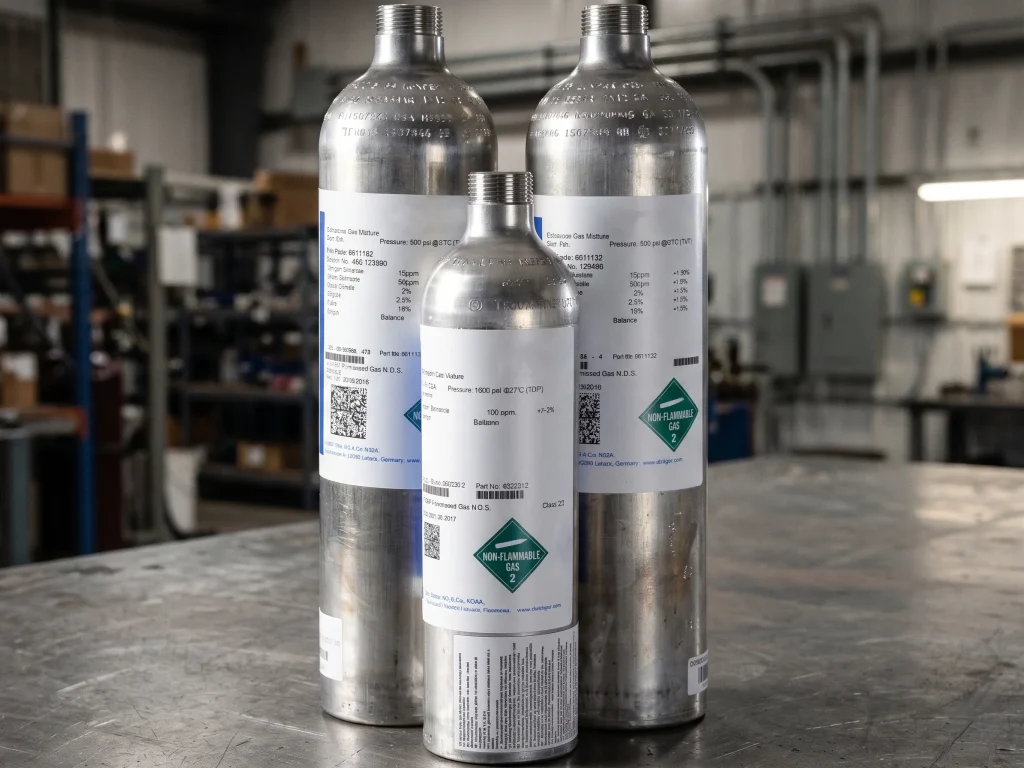
Calibration Gas Types and Where They're Used
- Bump Test Gas Mixtures: Used for quick checks before daily detector use to verify that sensors respond and alarms activate.
- Span Gas Mixtures: Used to check or calibrate an instrument against a known certified concentration. Adjustments may be needed if readings fall outside acceptable limits.
- Quad Gas Calibration Mixtures: Commonly used with four-gas monitors for confined-space entry. A typical mixture contains Hydrogen sulfide (H₂S): 25 ppm Carbon monoxide (CO): 100 ppm Oxygen (O₂): 18% Methane (CH₄): 50% LEL (approximately 2.5% by volume) Balance gas: Nitrogen
- Important: Gas concentrations vary by detector model. Always follow the manufacturer's specifications and instrument manual.
- EPA Protocol Gases: Used for applicable emissions monitoring and stack analyzer calibration. Refer to our Custom Gas Mixtures page for related information.
Find Your Calibration Gas
Choose a card to open a quote form with that gas type filled in. You can add target concentrations, pick a cylinder size or attach your spec sheet.
Quad Gas Calibration Mixture
Four-gas blend for H2S, CO, O2 and LEL monitors. Tell us your detector model so the levels match.
Portable Bump Test Cylinders
Small disposable cylinders for daily checks in the field. Light enough to live in a truck kit.
Single-Gas Span Gases
One target gas in a balance gas, for single-sensor detectors and fixed monitors.
Multi-Gas and Custom Blends
Five-gas mixes, PID gases and blends built to your own spec.
Get a Calibration Gas Quote
Send us your detector model, or the label from the cylinder you use now, and we'll match the mix and the regulator connection. Using calibration gas every week? We can set up scheduled reorders so your crews aren't left holding an expired cylinder.
Calibration Gas Cylinders and Regulators
Portable calibration gas cylinders are light, disposable aluminum or steel cylinders. Sizes like 34 L and 58 L are common for field kits. Fixed monitors and lab analyzers usually run from larger high-pressure calibration gas cylinders.
Match the regulator to the instrument. Diffusion detectors usually take a fixed-flow regulator, often set at 0.5 L/min. Detectors with a built-in pump need a demand-flow regulator, which only releases gas when the pump pulls it.
Here’s the rough math on how far a cylinder goes. A 30-second bump test at 0.5 L/min uses about a quarter liter, so a 58 L cylinder covers well over 100 bump tests. A full calibration runs longer and uses more gas.
Calibration Gas Shelf Life and Accuracy
Shelf life is really an accuracy question. After the expiration date, the concentration on the label may no longer match what’s in the cylinder. Stable mixes, like methane, carbon monoxide or oxygen in nitrogen, are often dated two to three years out. Reactive gases such as hydrogen sulfide, chlorine and ammonia slowly react with the cylinder’s inside surface. Those mixes often expire within about a year.
A mix expires on the schedule of its least stable gas. A quad gas cylinder carries H2S, so the H2S sets its date. Keep cylinders out of hot truck cabs between jobs, since repeated heating and cooling can shorten shelf life. Log the expiration date when a new cylinder arrives.
Custom Calibration Gas Mixtures vs. Standard Blends
| Comparison | Standard Blends | Custom Calibration Gas Mixtures |
|---|---|---|
| Best For | Routine portable gas detector testing | Specialized instruments and applications |
| Availability | Generally readily available and quicker to source | Requires specification and availability confirmation |
| Gas Composition | Predefined components and concentrations | Components, concentrations, and balance gas specified to requirements |
| Typical Applications | Routine detector testing | Specific solvents, ppb-level laboratory standards, or requirements not covered by stock blends |
| Balance Gas Options | Depends on the standard blend | May include nitrogen, zero air, or helium, depending on compatibility |
| Special Considerations | Check that the blend matches instrument requirements | Reactive gases, such as chlorine or ammonia, may require specially treated cylinders; confirm availability early |
Calibration Gas Supplier in Texas
As a calibration gas supplier in Texas, we deliver to Houston, Dallas, Fort Worth, Austin and San Antonio from our base in Flower Mound. Calibration gas can go on a scheduled delivery, so a fresh cylinder shows up before the current one expires. Running pipeline or oilfield jobs outside these metros? Call and ask about delivery to your area. We’ll give you a straight answer before you order.
Frequently Asked Questions
A bump test checks that the sensors and alarms respond, without adjusting anything. Span gas is used to check accuracy and to recalibrate the detector when its reading has drifted. Many crews use the same quad gas cylinder for both.
It’s a four-gas mix for monitors with H2S, CO, oxygen and combustible (LEL) sensors, balanced in nitrogen. Exact levels vary by detector maker, so match the one in your manual.
Yes. Each calibration gas cylinder from Southwest Gases comes with a Certificate of Analysis showing the certified concentrations, lot number and expiration date.
NIST traceability is available for calibration gas mixtures when your program requires it. Ask for it on your quote, and it will show on the certificate.
A calibration gas mixture generator dilutes a concentrated source gas to make several concentrations on demand. That suits multi-point lab or CEMS work, but the generator still needs a certified source cylinder plus a diluent such as nitrogen or zero air. For field detectors, a ready-mixed cylinder is simpler.
Tell us the detector or analyzer model, the gases and levels you need, and how many cylinders you use a month. Reach us at 214-432-6583 or sales@southwestgases.com, or use the form on this page.