
Helium for Semiconductor & Electronics Manufacturing in Texas
High-Purity Helium Supply for Wafer Processing, Leak Detection & Precision Electronics Manufacturing
Southwest Gases supplies ultra high purity helium to semiconductor and electronics manufacturers across Texas. We deliver 6N grade in cylinders, cylinder packs and bulk, with a certificate of analysis on every batch.
Trust indicators
- High-Purity Helium
- Reliable Delivery Scheduling
- Semiconductor-Grade Supply
- Texas Industrial Support
Why Helium Is Essential to Semiconductor & Electronics Manufacturing
In a fab, helium mostly does two things. It moves heat away from a wafer at low pressure, and it acts as the tracer gas for finding leaks that no other method will pick up.
Purity governs both. Semiconductor grade helium is 6N, or 99.9999 percent, which caps total impurities at 1 ppm against 10 ppm for 5N. The individual contaminants are what drive yield impact. Oxygen oxidizes silicon and copper interconnect surfaces. Moisture causes photoresist adhesion failures. Hydrocarbons deposit carbon on optical surfaces and cost you reflectance. Fabs running advanced nodes commonly specify oxygen, moisture and total hydrocarbons below 0.1 ppm each, well inside the 6N envelope.
We supply semiconductor helium to fabs, electronics assembly plants, vacuum equipment manufacturers, research cleanrooms and photonics facilities across Texas.
Common Helium Applications in Semiconductor & Electronics Facilities
Wafer Processing
Plasma etch and deposition chambers use helium behind the wafer as a heat-transfer gas. Controlled pressure helps move heat into the chilled chuck, maintaining uniform wafer temperatures and consistent etch rates. Multi-zone chucks use separate helium pressures to further improve temperature control across the wafer.
Helium Leak Detection
Fabs use helium for both inboard and outboard leak testing. Inboard testing checks new UHP gas and vacuum systems with a mass spectrometer, while outboard testing uses a sniffer probe on live, pressurized lines. We supply helium for both workflows, including fab installation and qualification projects.
Thermal Management
Helium’s high thermal conductivity makes it useful for rapid, uniform cooling. Applications include rapid thermal processing, ion implant beamlines, semiconductor testing and burn-in, and optical fiber drawing. High-volume fiber plants often use helium recovery systems to manage consumption and maintain efficient cooling operations.
Carrier & Purge Gas Applications
CVD and PECVD processes use helium as a carrier and diluent for precursor chemistry, helping maintain stable plasma conditions. Fabs also use helium to purge load locks, gas panels, transfer chambers, and tools, removing moisture and reactive gases between processing runs.
Research & Development
Prototype lines, university cleanrooms and advanced materials groups run the same tool sets at much lower volume. Orders tend to be small, irregular and urgent. We stock 6N cylinders for accounts that order two or three at a time, with the same certificate of analysis that goes to a production account.
High-Purity Helium Supply Backed by Local Texas Support
Helium has no process substitute in backside cooling or in leak testing. When supply tightens, tools stop. We source domestically where we can and hold redundant supply agreements. Scheduled accounts get priority allocation during constrained periods.
Beyond the gas, our specialists work with facilities and process teams on supply sizing during tool installs and ramps, on purity documentation for qualification packages, and on flexible agreements that can move with production volume. Deliveries run on our own fleet, and 24/7 emergency dispatch covers unplanned demand during a ramp or after unscheduled tool downtime. Southwest Gases has supplied Texas industry for over 30 years, and every account works with the same specialist.
Helium Supply Solutions for Semiconductor Facilities
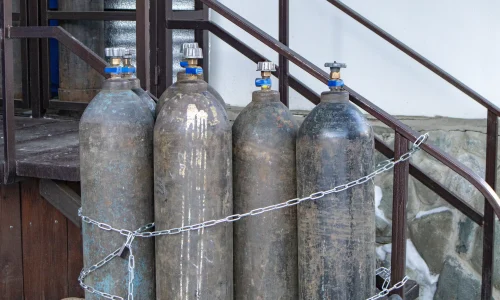
High-Pressure Helium Cylinders
Cylinders and cylinder packs cover tool-level supply, laboratories and pilot production. Sizes run from single high-pressure cylinders on a CGA 580 outlet up to manifolded quads and 12-packs for higher-draw tools. For UHP service the connection matters as much as the gas: specify VCR face-seal fittings and a purge panel at the point of use, because most contamination at this scale enters during changeout rather than in the cylinder.
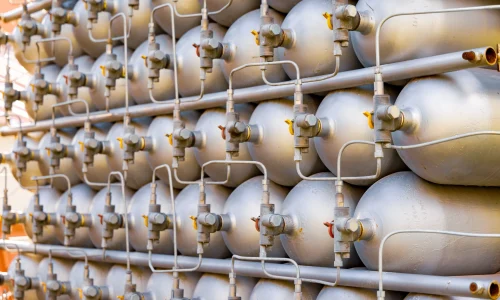
Bulk Helium Supply
Continuous manufacturing and centralized gas systems are supplied from liquid helium in bulk vessels or from gaseous tube trailers, depending on draw rate and site layout. Bulk is where unit cost drops and where telemetry earns its keep, since level-triggered replenishment removes the guesswork from a gas with no substitute. We size vaporization and backup capacity against peak demand.
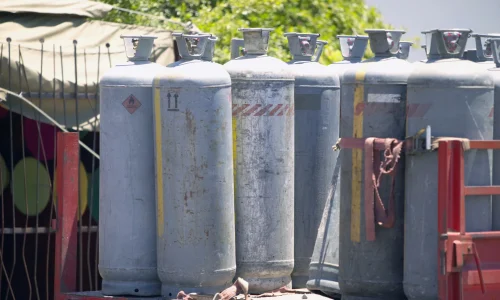
Scheduled Delivery Programs
Scheduled programs suit predictable consumption and multi-site operations. Intervals come from measured usage and get revised as tools come online during a ramp. Accounts on a scheduled program hold priority allocation when supply tightens.
Serving Semiconductor & Electronics Manufacturers Across Texas
Texas ranks second in the United States for semiconductor manufacturing, with 13 or more existing or announced fabs and component plants. Our routes follow that footprint.
In Central Texas we deliver along the I-35 corridor through Austin, Round Rock and the Williamson County buildout. In North Texas we cover Dallas, Fort Worth, Richardson and Plano, and run north toward the Sherman fab cluster. Houston and San Antonio are served for electronics assembly, test operations, specialty manufacturing and photonics. The account base runs wider than fabs themselves and includes equipment makers, subfab and gas system contractors, packaging and test houses, and PCB and electronics assembly plants.
Get a Reliable Helium Supply Partner for Your Semiconductor Facility
Certified 6N helium, sized to your tool count and ramp plan, with technical support and emergency dispatch across Texas. Call 214-432-6583 or email sales@southwestgases.com.
Frequently Asked Questions
Semiconductor manufacturing generally requires 6N helium, meaning 99.9999 percent purity with total impurities at or below 1 ppm. Advanced-node fabs go further and specify individual limits, commonly below 0.1 ppm each for oxygen, moisture and total hydrocarbons. Back-end operations such as assembly, test and leak checking often run acceptably on 5N at 99.999 percent.
Helium has a very small atomic size, so it passes through leak paths that other tracer gases will not enter, and ambient air contains only about 5 ppm helium, which leaves almost no background signal to mask a real leak. It is also inert and non-flammable, so it can be introduced into a tool or gas line without risk to the hardware. Detection limits reach the 10 to the minus 11 mbar L/s range on a well-set-up instrument.
Yes. Bulk supply comes as liquid helium in vacuum-insulated vessels or as gaseous helium in tube trailers, chosen on draw rate and site layout. Bulk lowers unit cost against cylinders and supports centralized distribution to multiple tools. We size storage, vaporization and backup capacity against peak demand and add telemetry so replenishment triggers on level.
Yes. Scheduled helium delivery in Texas covers Austin, Round Rock, Dallas, Fort Worth, Richardson, Plano, Houston and San Antonio, with route coverage extending north toward Sherman. Intervals are set from measured consumption and revised as tools come online. Scheduled accounts also hold priority allocation during constrained supply periods.
Beyond wafer fabs, helium is used by electronics assembly plants for leak testing sealed devices, by vacuum equipment manufacturers qualifying chambers before shipment, by optical fiber and photonics producers for cooling and controlled atmospheres, by display and MEMS manufacturers, and by hard drive makers, since sealed helium-filled drives depend on it. Test and burn-in operations use it for thermal control.
Its main role is backside cooling. During plasma etch or deposition the wafer is clamped to an electrostatic chuck and helium is fed into the gap beneath it, usually at 2 to 3 Torr, so the gas layer conducts heat from the wafer into the temperature-controlled chuck. Multi-zone chucks run inner and outer zones at separate pressures to hold temperature uniformity, which controls etch rate uniformity and critical dimensions.
Yes. We start from tool count, draw rate per tool and duty cycle, then work out whether packs, bulk or a combination fits the site. Ramp plans matter as much as current usage, since a supply system sized to today gets replaced within a year on a growing line. Site assessments are available across our Texas service area.
Yes. We run 24/7 emergency dispatch across Texas. Call 214-432-6583 with your grade, connection type and volume, and we will confirm what we can move and when.
The N number counts the nines. 5N is 99.999 percent pure, allowing up to 10 ppm total impurities. 6N is 99.9999 percent, allowing 1 ppm. In practice the more useful question is which impurities are certified and at what level, because 1 ppm of moisture affects a process very differently from 1 ppm of nitrogen. Ask for the full certificate of analysis rather than the grade name.
Yes, and it is worth doing at volume. Recovery systems capture helium from tool exhaust, purify it and return it to the supply line, with recovery rates reported from roughly 55 percent up to 95 percent depending on the process and the contamination load. The constraint is time and capital: retrofitting an existing facility is commonly quoted at 12 to 18 months. Recovery reduces purchased volume, so it is worth planning at the same time as a supply agreement.